
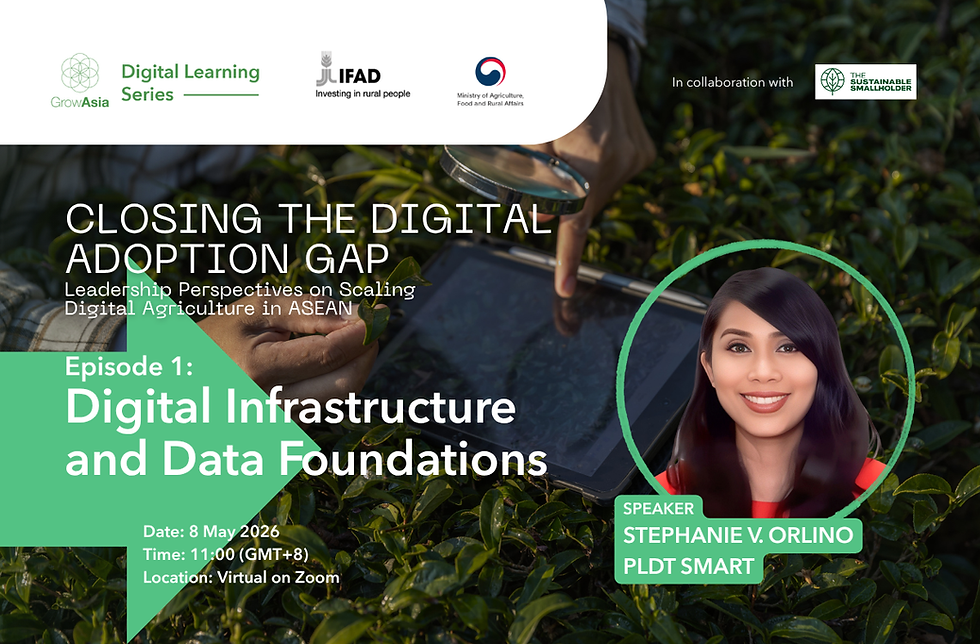
Closing the Digital Adoption Gap | Episode 1: Digital Infrastructure and Data Foundations
Throughout May 2026, the Grow Asia Digital Learning Series (DLS) ran a three-part fireside chat series, Closing the Adoption Gap: Leadership Perspectives on Scaling Digital Agriculture in ASEAN. Hosted by Erika Balzarelli of The Sustainable Smallholder, lead author of Grow Asia's report Accelerating Smallholder Adoption at Scale in ASEAN: Strategic Pathways, the series brought together leaders from telecommunications, agri-fintech, and development finance to explore a central question: if the technology exists, what is preventing digital agriculture from reaching scale?
The DLS is part of the regional GrowVentures Impact Fund, supported by IFAD and the Ministry of Agriculture, Food and Rural Affairs of the Republic of Korea. Across all three episodes, a consistent message emerged: scaling digital agriculture is not primarily a technology challenge. Success depends on the systems, partnerships, incentives, and people that enable solutions to reach farmers and create lasting value.
Episode 1: Digital Infrastructure and Data Foundations
The series opened with Stephanie Orlino, Head of Stakeholder Engagement at PLDT and Smart, the Philippines' largest integrated telecommunications company.
While connectivity, smartphone penetration, and farmer registries continue to improve across the Philippines, the discussion highlighted a persistent gap between digital infrastructure and farmer adoption. The challenge is not only building the individual components of a digital ecosystem, but ensuring they work together in a way that delivers value for farmers.
A key theme was the role of the private sector in supporting Digital Public Infrastructure (DPI). Beyond providing connectivity, companies such as PLDT and Smart can help connect data systems, services, and stakeholders to create a more enabling environment for digital agriculture.
The discussion underscored that infrastructure challenges are as much about coordination and ownership as they are about technology.
Comments